If your transfers are printing well but the finished garments still feel inconsistent. The press is usually where the problem starts. When businesses compare the top heat presses for DTF. They are not simply choosing a machine that gets hot. They are choosing how reliably they can produce saleable work, how quickly they can move through jobs, and how much operator error they can remove from the process.
In DTF production, the heat press is not an accessory. It is a core part of the system. A strong printer and quality consumables can still be let down by uneven temperature. Also poor pressure control or a platen size that slows everything down. That is why selecting the right press should be based on workload, garment mix and production expectations rather than headline price alone.
What makes a heat press suitable for DTF?
DTF is relatively forgiving compared with some decoration methods, but only up to a point. To achieve a clean bond, a smooth finish and dependable wash performance, you need even heat across the platen, repeatable pressure and accurate dwell time. If any of those three are inconsistent, the result can be patchy adhesion, edge lift, poor peel performance or an uneven handle on the garment.
For commercial users, pressure matters just as much as temperature. Many lower-cost presses can reach the required heat setting, but they often struggle to apply even pressure across the full print area. That becomes more obvious on larger logos, full-front designs and gang sheets where one side may press cleanly while another side underperforms.
Build quality also matters more than many first-time buyers expect. A press used all day in a busy garment decoration environment needs to open and close cleanly, maintain calibration and cope with repetitive use without drifting out of tolerance. Downtime on a heat press does not just stop one stage of production. It disrupts your whole workflow.
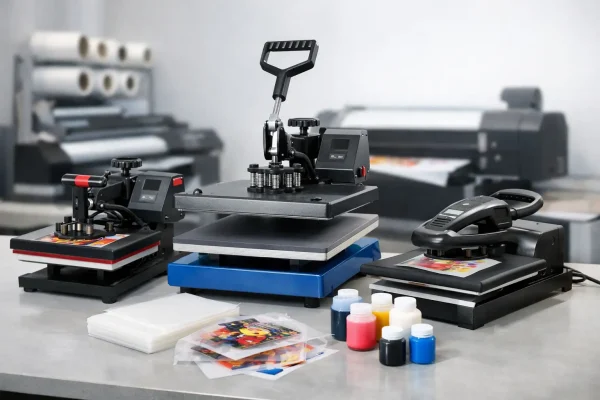
The top heat presses for DTF by press type
Rather than ranking brands in the abstract, it is more useful to look at the main press types and where each one fits in a real production setting. The best choice depends on whether you are starting out, adding DTF to an existing business or building for volume.
Clamshell heat presses
A clamshell press is often the entry point for smaller businesses because it is compact, straightforward to use and generally more affordable than swing-away or pneumatic alternatives. For start-ups with limited floor space, that compact footprint can make a genuine difference.
The trade-off is access. Because the upper platen opens upwards, loading garments can feel tighter, especially around seams, collars and thicker items. On basic models, pressure distribution can also be less even towards the back of the platen. That does not make clamshell presses unsuitable for DTF, but it does mean quality varies sharply between entry-level and well-engineered commercial units.
If your workload is modest and your print areas are fairly standard, a good clamshell can be a sensible starting point. If you are pressing all day, every day, you may outgrow it quickly.
Swing-away heat presses
For many garment decorators, swing-away models sit in the sweet spot between accessibility and control. The upper platen moves completely away from the lower platen, giving the operator a clearer working area and reducing the chance of accidental contact when positioning garments and transfers.
This design is particularly helpful when handling larger prints or awkward placements. It also tends to support more even pressure across the platen, which is one reason swing-away presses are often preferred for businesses focused on consistency rather than just cost.
The downside is space. A swing-away press needs room for the arm to move, so it is not always the best fit in a tight workshop. It can also be slower in high-volume environments if the operator is repeatedly swinging the platen in and out throughout the day.
Pneumatic heat presses
If output volume is increasing and operator fatigue is becoming a factor, pneumatic presses deserve serious consideration. These use air pressure rather than manual closing force, which means the pressure is more repeatable from one press cycle to the next and far less dependent on the operator.
That consistency is valuable in DTF production. It helps reduce variation across shifts, across staff and across larger order runs. Pneumatic presses are also easier on the body, which matters in commercial environments where repetitive strain and fatigue can affect productivity over time.
The trade-off is cost and setup. Pneumatic equipment requires a compressor and a little more planning around installation. For businesses with steady order flow, that added investment can be well justified. For low-volume users, it may be more machine than they currently need.
Dual-platen and shuttle presses
For businesses pressing at scale, dual-station or shuttle-style presses can transform throughput. While one platen is under heat, the other can be loaded or unloaded. That cuts dead time and creates a more efficient rhythm, especially when handling repeat jobs.
These presses are less about basic capability and more about production efficiency. If your bottleneck is no longer print quality but the speed of fulfilment, this type of setup can make a measurable difference. It is especially useful where DTF is one part of a broader garment decoration operation and the press needs to keep pace with incoming transfers.
The obvious consideration is budget, followed closely by workspace. They are designed for businesses that already know they need production capacity, not for cautious entry into the market.
What to look for beyond the specification sheet
The published specification tells only part of the story. Temperature range, platen size and timer settings are relevant, but the real question is how the press performs under daily commercial use.
The first thing to assess is temperature accuracy. A press that shows one figure on the display but delivers another on the platen can create persistent quality problems that are hard to diagnose. The second is pressure consistency across the whole pressing area. A machine may appear satisfactory on smaller left-chest jobs but start to fail on larger artwork.
Platen size should match your typical order profile. A smaller press may seem economical, but if you are regularly repositioning garments or pressing in stages, you introduce more labour and more opportunities for error. Equally, buying the largest available press is not always the right move if your work is mainly smaller placements and your space is limited.
Peel process is another practical consideration. Hot peel and cold peel workflows place different demands on operator timing and throughput. A reliable press helps standardise that process, especially when multiple staff are involved.
Choosing the right heat press for your business stage
For a start-up, the best press is usually the one that delivers dependable results without stretching the budget to the point that the rest of the setup suffers. It is rarely wise to overspend on the press while underinvesting in the printer, curing process or consumables. At this stage, a well-built manual press can be the right commercial decision.
For an established print shop adding Top Heat Presses for DTF, the calculation is different. You may already understand production pressure, staffing and turnaround expectations. In that case, a stronger swing-away or pneumatic model often makes more sense because it supports consistency from day one and fits more comfortably into a professional workflow.
For higher-volume operators, the question becomes less about whether a press can perform and more about how efficiently it can do so. That is where pneumatic and dual-station systems begin to justify themselves. They reduce variation, increase output and take pressure off operators in a very literal sense.
Support matters as much as the machine
Heat presses are often sold as simple equipment, but in practice they are part of a working production system. Setup, calibration, training and troubleshooting all affect the result on the garment. Businesses usually feel this most clearly when they buy on price and then discover they are largely on their own once the machine arrives.
For commercial Top Heat Presses for DTF users, practical support has real value. Guidance on pressure settings, transfer application, workflow layout and maintenance can shorten the learning curve and prevent expensive waste. That is one reason many businesses choose a specialist supplier such as DTF Magic® rather than treating the heat press as a stand alone purchase.
A good supplier should help you match the press to your actual workload, not simply sell the largest model available. The right advice at the start can save far more than the initial price difference between machines.
When a cheaper press becomes expensive
It is easy to focus on purchase price, especially when entering a new market. But the real cost of a heat press shows up in rejects, reworks, wasted garments, slower production and avoidable downtime. A machine that saves money upfront but creates inconsistency later is not the cheaper option for long.
That does not mean every business needs a premium pneumatic setup from the outset. It means the press should be judged by commercial output, not just list price. If it holds temperature accurately, applies pressure evenly and fits the pace of your operation, it is doing its job properly.
The best Top Heat Presses for DTF are the ones that support repeatable results with the least friction in your workflow. If you choose with that in mind, you will make a far better decision than simply chasing the lowest ticket price.