How to Buy DTF Printer
The wrong DTF printer does not just waste budget – it slows production, creates avoidable reprints and leaves your team chasing faults instead of fulfilling orders. If you are working out how to buy dtf printer equipment for a real business, the decision needs to be based on output, support and the full production setup, not just the headline machine price.
For most UK garment decorators, the best buying decision is not the cheapest printer on the market. It is the system that gives you dependable transfer quality, manageable running costs and support when production pressure is on. That is particularly true if you are starting DTF for the first time or adding it to an existing print operation where downtime has a direct commercial cost.
How to buy a DTF printer without buying the wrong setup
A DTF printer should be treated as one part of a production system. Buyers often focus heavily on print width, printhead type or advertised speed, then discover later that curing, powder application, ink handling and heat pressing have just as much impact on results. A good buying process starts with the work you need to produce every week, then builds backwards from there.
If you mainly run short custom orders, names, logos and repeat garment work, you may not need the largest or fastest printer available. What you do need is consistency, straightforward operation and a workflow that your staff can manage confidently. If you are producing higher daily volumes, then print speed, media handling and automation become much more important. The right answer depends on the orders you actually expect, not the machine that looks most impressive on paper.
It is also worth being realistic about your business stage. A start-up can damage cash flow by overbuying, while an established print shop can lose margin by choosing an entry-level setup that cannot keep up with demand. Good advice should balance current workload with sensible room for growth.
Start with output, not specifications
The first question is simple: how many transfers or garments do you need to produce on a normal day, and what happens if demand increases? That figure shapes almost every other buying decision.
A lower-volume business may be well served by a compact printer and curing setup that is easy to operate and maintain. A busier production environment usually needs more than speed alone. It needs stable film feeding, dependable white ink circulation, predictable curing and equipment that can run consistently across longer shifts.
This is where many buyers get caught out. A machine may look affordable at first glance, but if it struggles with white ink management, requires frequent intervention or lacks dependable technical backup, the real cost shows up later in wasted film, spoiled transfers and lost production time. Commercially, those issues matter far more than a modest saving on purchase price.
What a complete DTF production setup should include
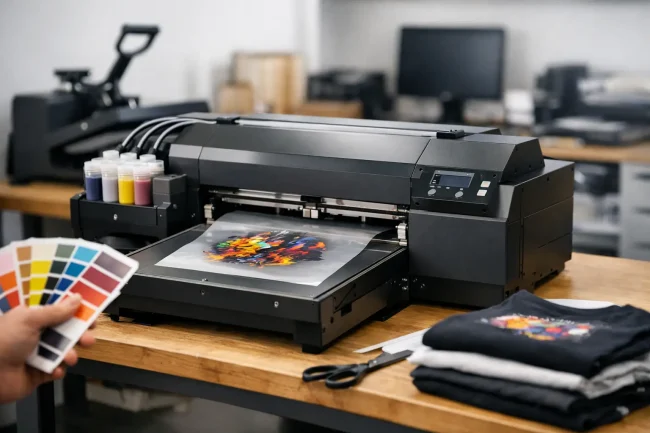
If you are researching how to buy a DTF printer, make sure you are pricing the entire workflow rather than a standalone printer. A proper setup usually includes the printer itself, curing equipment, a heat press, DTF inks, film, powder and often an ink stirring or circulation solution to help maintain white ink performance.
Installation and training should also be treated as part of the purchase, not optional extras. DTF can produce excellent results, but it is still a production process with variables to control. Your team needs to understand how to load media correctly, manage temperature settings, store consumables properly and identify issues before they turn into waste.
A supplier that only posts out a box leaves too much to chance. A supplier that helps you install the system, demonstrates correct operation and provides ongoing technical support gives your business a much stronger start. That support becomes even more valuable when orders are building and you need answers quickly.
The hidden cost of buying on price alone
Cheap equipment can be expensive to own. That is not a sales line. It is a production reality.
Low-cost machines are often sold with limited guidance, unclear maintenance expectations and inconsistent access to parts or consumables. If something goes wrong, you may find yourself relying on trial and error or waiting for answers that do not come when you need them. For a hobby user that may be frustrating. For a business with customer deadlines, it can become a serious problem.
The better question is not, “What is the cheapest DTF printer I can buy?” It is, “What setup gives me reliable output with support behind it?” Reliability protects margin. So does access to the right ink, film and powder from a supplier that understands the system being used.
This is why experienced buyers tend to look at total ownership cost rather than ticket price. Consumable compatibility, maintenance routines, technical backup and workflow efficiency all affect profit over time.
How to assess the supplier as well as the machine
A DTF printer supplier should be judged on more than product listings. Ask what happens after delivery. Will the machine be installed? Will your staff receive training? Is help available when you are troubleshooting print quality or curing issues? Can you continue sourcing matched consumables and replacement parts without unnecessary disruption?
Those questions tell you whether you are buying from a genuine production partner or a basic reseller. The difference matters. DTF printing is far easier to run successfully when the equipment, consumables and support are aligned.
It is sensible to ask for a demonstration or a clear explanation of expected workflow before you commit. You want to see realistic output, not just ideal samples. A dependable supplier should be comfortable discussing maintenance, print consistency, operating requirements and the type of business the setup best suits.
For many UK buyers, local support also matters. Time zones, service response and practical familiarity with UK business needs can make a noticeable difference when you need assistance quickly.
Space, power and workflow still matter
Before you buy, look honestly at where the equipment will sit and how jobs will move through production. A DTF setup needs more than floor space for the printer. You need room for curing, pressing, consumable storage and safe, organised handling of printed film.
Power requirements, ventilation and operating conditions should be checked in advance. A machine that fits physically may still create bottlenecks if the surrounding workflow is poorly planned. Think about who will run it, where finished transfers will go and how quickly jobs need to move from print to press.
This is especially important for businesses adding DTF to an existing decoration environment. If your team already handles embroidery, vinyl or screen printing, the new setup should support your current operation rather than disrupt it. Good planning reduces wasted movement, operator confusion and production delays.
Buying for growth versus buying for now
There is no value in paying for capacity you will not use, but there is also no value in buying a system you outgrow within months. The right balance depends on your order profile, sales pipeline and staffing.
If DTF will be a side offering for occasional work, keep the setup proportionate. If it is becoming a central production method for custom apparel or transfer supply, it makes sense to invest in equipment that can scale with the business. That may mean stronger automation, better curing capability or a more efficient overall workflow from the outset.
This is where experienced guidance really earns its place. A supplier that understands production can help you avoid both under-specifying and overcommitting. That is usually a better route than buying based on online comparisons alone.
A practical way to decide
When comparing options, bring the decision back to five practical questions. Can this setup produce the volume I need? Will the output quality be consistent enough for paying customers? Are training and after-sales support included? Can I source the right consumables reliably? And if something goes wrong, who helps me get back into production?
If you can answer those confidently, you are much closer to a sound purchase. If you cannot, the machine is probably not the right fit yet, whatever the price or specification sheet says.
For businesses that want to get DTF right first time, a complete solution is usually the safer investment. That is why many buyers choose a specialist supplier such as DTF Magic®, where equipment, consumables, installation and support are built around real production needs rather than one-off transactions.
A DTF printer should help your business produce more, waste less and deliver confidently under pressure. Buy with that in mind, and the right machine becomes more than equipment – it becomes part of a dependable workflow you can build on.