DTF Transfers Equipment
If you are asking about DTF Transfers Equipment, the real question is usually this: what do you need to produce transfers consistently, profitably and without avoidable downtime? That matters far more than buying a single printer and hoping the rest falls into place. A workable DTF setup is a production system, not a standalone machine.
For start-ups, the temptation is to focus on the lowest entry price. For established print businesses, the risk is assuming DTF can be slotted into an existing workflow with very little planning. In both cases, the same rule applies – the right equipment depends on your output targets, available space, staffing and the level of support behind the system.
What equipment does DTF need for production?
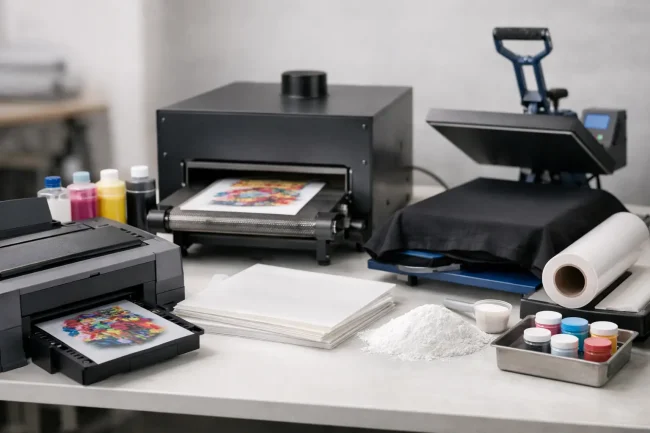
At a minimum, DTF production requires a printer, DTF inks, PET film, adhesive powder, a curing method and a heat press. That is the short answer. The more useful answer is that each part affects every other part.
A printer may be capable of excellent image quality, but if the ink circulation is poor or the curing stage is inconsistent, the final transfer will still fail. Equally, strong artwork means little if the press cannot apply even pressure and temperature across the garment. Commercial DTF works best when the equipment is chosen as a matched process rather than as individual bargains.
The DTF printer
The printer is the starting point of the workflow. It lays down the colour and white ink layers onto the film, so printhead reliability, ink delivery and media handling all matter. For commercial users, this is not simply about resolution figures on a specification sheet. It is about dependable daily output.
A proper DTF printer should be built for this application rather than loosely adapted for it. Stable white ink management is especially important, because white ink naturally settles and can create blockages if the system is poorly designed or badly maintained. This is one reason businesses often benefit from supplier installation and training rather than trying to assemble a setup from mixed sources.
Printer choice also depends on volume. A smaller operation producing short runs may need a compact system with manageable running costs. A growing business with repeat trade and trade customers may need faster output, wider film capacity and a more scalable workflow. Buying too small can create a bottleneck very quickly, but buying too large can tie up capital unnecessarily if your order profile does not justify it.
DTF inks
DTF inks are not an accessory purchase. They are a core part of the system and need to be compatible with the printer and production conditions. Poor ink choice can affect print vibrancy, white coverage, wash performance and printhead stability.
In a commercial environment, consistency matters more than chasing the cheapest bottle price. Ink that behaves unpredictably can cost more in wasted film, remakes and machine maintenance than it saves at the point of sale. For that reason, many businesses prefer to stay within a supported ecosystem where the machine, inks and technical advice are aligned.
PET film
The film carries the image from print stage to garment application, so it needs to feed correctly through the printer, accept the ink cleanly and release properly during pressing. Hot peel, cold peel and warm peel films each suit different production preferences.
This is one of those areas where it depends on your workflow. Some operators prioritise speed and prefer film that fits a faster production rhythm. Others place more value on handling characteristics or finish. Film quality also affects powder hold, image definition and transfer feel, so it should never be treated as a minor consumable.
Adhesive powder
The powder bonds the printed image to the garment during pressing. If the powder grade is wrong, or if application is uneven, the transfer can crack, fail to adhere properly or leave an undesirable finish.
Different powders can suit different fabric types, handle requirements and working conditions. A busy production room with changing temperatures and humidity may expose weaknesses in lower-grade materials very quickly. Good powder application and curing are just as important as good printing.
The equipment that completes the workflow
Many problems in DTF are not printing problems at all. They happen after the image is printed, during powdering, curing and pressing. That is why a complete setup includes more than the printer itself.
Powder application and curing
Once the film is printed, adhesive powder must be applied and then cured so the transfer is ready for pressing. Some smaller users begin with manual powdering and a compact curing solution. That can work at lower volumes, particularly when budget and floor space are tight.
As production increases, automated or more controlled curing equipment becomes much more important. It improves consistency, reduces handling variation and helps maintain a steadier workflow. If you are fulfilling paid customer orders every day, reducing manual inconsistency has a direct commercial benefit.
Curing is especially important because under-cured powder can lead to poor adhesion, while over-curing can affect transfer performance and finish. Reliable curing equipment gives you repeatable conditions rather than guesswork.
Heat press
A heat press is not optional in DTF. It is the stage that applies the transfer to the garment under controlled heat, pressure and dwell time. Even an excellent transfer can be ruined by a poor press.
For professional use, the press needs accurate temperature control, consistent pressure across the platen and enough build quality to cope with regular use. Swing-away and pneumatic options may suit different business models, but the principle is the same: you need even application and repeatability.
This is one area where underinvestment often shows up quickly. Uneven pressing leads to partial adhesion, inconsistent finish and wasted garments. For businesses supplying retail brands, workwear, events or promotional orders, that is not a small issue. It affects margins and reputation.
What additional DTF equipment is often overlooked?
DTF Transfers Equipment is not complete without the support equipment around the main machines. These are the items that make a system easier to run and easier to maintain.
Ink stirring and circulation support
White ink requires proper management. Ink stirring units and circulation support help reduce settling and improve consistency, particularly in busier environments or where machines are not running continuously throughout the day.
This may sound like a technical extra, but it has a practical purpose. Better ink condition supports better print performance, fewer interruptions and less avoidable maintenance.
Extraction and workspace planning
Your production area needs suitable ventilation, sensible layout and enough room for loading film, curing transfers and pressing garments safely. DTF should be planned as a working production space, not squeezed onto the nearest spare bench.
A cramped layout slows operators down and increases the chance of handling errors. If garments, films and consumables are constantly being moved around to make room, output suffers. Good workflow planning saves time every day.
RIP software and artwork control
DTF production also depends on software that manages print settings, colour handling and white ink laydown. Reliable RIP software helps control output and repeat jobs consistently.
For commercial users, this matters because repeatability is often more valuable than theoretical maximum quality. A customer reordering the same design expects the same result. Software settings, profiling and operator training all contribute to that consistency.
Cleaning and maintenance supplies
Routine maintenance is part of running DTF equipment properly. Cleaning solutions, wipes, capping station care products and the right maintenance procedures help protect the print system and reduce downtime.
This is another area where supplier support has real value. Businesses do not just need a box of parts. They need clear guidance on what to do daily, weekly and when problems appear.
Choosing the right setup for your business
Not every business needs the same DTF Transfers Equipment setup. A new entrant selling personalised garments online may begin with a compact production line and a clear plan for growth. An established decorator adding DTF to support short runs, tricky fabric types or trade fulfilment may need a more integrated system from the outset.
The best approach is to work backwards from your expected order volume, turnaround commitments and staffing. Ask how many metres or sheets you need to produce each day, how many garments must be pressed per hour and how much downtime your business can realistically absorb. Those answers usually point to the right level of DTF Transfers Equipment more accurately than headline machine prices.
It also pays to think beyond the initial installation. Training, demonstrations, consumable supply and accessible technical help are part of the equipment decision, because they affect how quickly you become productive and how confidently you can keep running. That is why many businesses prefer a complete, supported solution from a specialist such as DTF Magic® rather than assembling machines and materials from multiple sellers.
A good DTF setup should feel dependable from day one, but it should also leave room for growth. If your equipment can deliver consistent transfers, support your production targets and come with knowledgeable backup when needed, you are in a far stronger position to build profitable print work. Start with the workflow, not the headline machine, and the investment tends to make much better sense.