A customer wants 25 full-colour left chest logos by tomorrow, another needs a short run of oversized festival tees, and your press schedule is already tight. That is exactly where custom DTF transfers start to make commercial sense. For garment decorators, print shops and promotional product businesses, they offer a practical way to handle varied artwork, mixed quantities and demanding turnaround times without compromising finish.
Why custom DTF transfers suit modern print workflows
Custom DTF transfers have become a strong option for businesses that need flexibility without losing control over quality. They allow you to apply detailed, full-colour designs to a wide range of garments and fabrics, which is particularly useful when your order book includes everything from cotton T-shirts and hoodies to workwear, tote bags and performance garments.
The appeal is not just visual quality. It is operational. When you can hold ready-to-press transfers or produce them as part of your own workflow, you reduce some of the bottlenecks that come with screen set-up, weeding, or managing multiple decoration methods for different fabric types. That matters when your margins are tied closely to labour time, spoilage and repeatability.
For start-ups, the attraction is often accessibility. For established decorators, it is more likely to be capacity, versatility and the ability to take on work that may have been awkward or unprofitable with another method. Those are different starting points, but both lead to the same question – can this process produce dependable output day after day?
What makes custom DTF transfers commercially useful
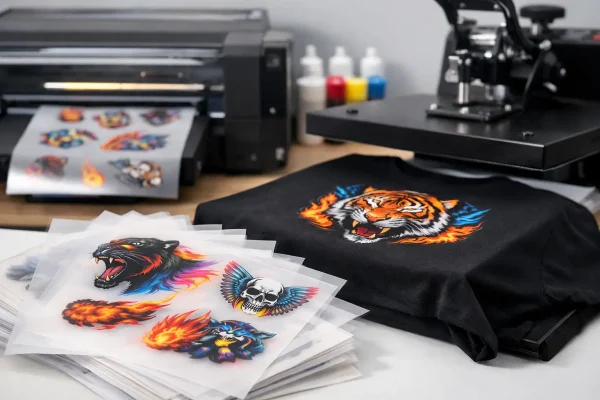
At a practical level, the process is straightforward. A design is printed onto film using DTF inks, adhesive powder is applied, the print is cured, and the finished transfer is then heat pressed onto the garment. The reason the market has moved quickly is that this sequence gives businesses a useful mix of image quality and production flexibility.
Fine lines, gradients and photographic detail reproduce well when the system is set up properly. Small text and complex logos that may be difficult in other processes can often be handled cleanly. That makes custom DTF transfers particularly useful for branding work, event apparel, sportswear names and numbers, and small-run custom orders where design variation is high.
There is also less compromise across garment types than many businesses expect. While every fabric should still be tested, DTF can perform well across a broad range of materials. For a commercial operator, that means fewer conversations about what can and cannot be decorated using one method.
That said, there are trade-offs. DTF is not automatically the best answer for every job. Very high-volume runs with simple spot colour artwork may still favour screen print on cost efficiency. Premium fashion applications may call for a specific hand feel that leads you elsewhere. The right choice depends on your order profile, your customers’ expectations and how you want to structure production.
Choosing between buying transfers and producing your own
This is often the real decision for growing businesses. Some companies benefit most from ordering ready-made custom DTF transfers, while others gain more value by bringing production in-house.
Buying transfers can be the sensible route if you want to expand your product offer without committing immediately to a full print line. It lowers the barrier to entry, reduces technical variables and allows you to focus on pressing, finishing and fulfilment. If your volumes are still developing or your order pattern is unpredictable, this approach can protect cash flow while letting you test demand properly.
Producing your own transfers is a different commercial step. It gives you more control over turnaround, scheduling and repeat work. It can improve margins at scale, especially if you are printing regularly and managing a steady stream of custom jobs. It also gives you freedom to respond quickly when customers change artwork, quantities or garment choices at short notice.
The important point is that equipment alone does not create reliable output. A proper DTF setup includes the printer, curing capability, heat press performance, consumables, workflow knowledge and technical support behind it. Businesses that underestimate that often find that inconsistency comes not from the print process itself, but from gaps in installation, training or maintenance.
The production factors that affect results most
If you are assessing custom DTF transfers seriously, image quality is only one part of the picture. Consistency across repeated jobs is what determines whether the process helps your business or creates rework.
Artwork preparation matters more than many buyers realise. Clean file setup, appropriate sizing, correct colour handling and suitable resolution all affect the final transfer. Poor artwork can still produce a disappointing result even with good equipment and materials.
Application settings are equally important. Press temperature, dwell time and pressure need to be matched to the transfer and garment. Too much heat can affect the finish. Too little pressure can reduce adhesion. The same transfer may behave differently on a lightweight fashion tee than on a heavier workwear fleece, so disciplined testing is part of professional production.
Consumable quality should not be treated as an afterthought. Ink performance, film behaviour and powder consistency all influence output and wash durability. A lower purchase price on consumables can become expensive very quickly if it causes blocked heads, unstable prints or failed garments.
Then there is maintenance. In a commercial environment, printers need regular care, stable operating conditions and sensible workflow management. If your business relies on dependable delivery dates, the support available after installation becomes as important as the original machine specification.
Custom DTF transfers and the question of scale
One of the strongest reasons businesses adopt this method is that it scales more comfortably than many assume. A small operator can start by offering custom DTF transfers to broaden its service range. A larger print business can use the same process to remove pressure from existing decoration departments, take on more varied order types or improve responsiveness for short-run custom work.
Scale, however, is not just about output speed. It is about whether the whole system holds together when order volume increases. Can your curing stage keep pace with print demand? Is your heat press setup fast and consistent enough to avoid creating a bottleneck further down the line? Are staff trained well enough to maintain standards during busy periods?
These are the questions that shape return on investment. A cheaper route in can become costly if it limits throughput or creates quality variation. A more complete setup often gives better value over time because it supports stable production rather than simply ticking a specification box.
That is why many commercial buyers look for a supplier relationship rather than a transaction. If you are building or upgrading a DTF workflow, installation guidance, demonstrations, training and after-sales support reduce risk. They also shorten the learning curve and help you reach saleable output sooner.
What to look for before you commit
When evaluating custom DTF transfers or a full production setup, focus on what affects your working day. Ask how reliably the process handles your typical order mix. Consider whether your jobs are mostly one-offs, repeat business, branded workwear, fashion retail or event merchandise. The right answer for one production model may not be the best fit for another.
Look closely at support. If a supplier can explain the complete workflow, help with installation requirements and provide practical technical backup, that has real value. It means fewer avoidable mistakes and more confidence when you are under deadline pressure.
It is also worth being honest about your internal capacity. If your team is small and already stretched, ready-to-use transfers may be the smarter commercial choice in the short term. If you have the demand, space and commitment to manage production properly, bringing custom DTF transfers in-house could give you stronger control and better long-term efficiency.
For UK businesses, dependable service matters just as much as machinery. Fast answers, accessible technical help and clear consumables supply all affect your ability to keep orders moving. That is one reason businesses often choose specialist partners such as DTF Magic® rather than buying from a basic online seller with limited backup.
Where custom DTF transfers fit best
The strongest use case is not a single niche. It is any business that needs durable, detailed decoration with room for variation. That includes start-ups wanting a credible route into garment print, established shops that need another production method, and commercial operators trying to improve turnaround without adding unnecessary complexity.
Custom DTF transfers are especially effective when your customers expect variety. If you are handling multiple garment types, changing designs, personalised names, seasonal campaigns or small branded runs, the process offers a level of flexibility that can make your production floor more responsive and more profitable.
The value is clearest when the setup behind the process is right. Good equipment, good consumables and good support tend to show up in the same places – fewer failed garments, steadier output, less downtime and more confidence when the order book gets busy.
If you are considering custom DTF transfers, the best next step is not to chase the cheapest option. It is to choose a route that matches your workload, your growth plans and the level of support you will need when production starts to matter most.