A customer wants 25 full-colour hoodies on Monday, 6 one-off staff polos on Wednesday, and a short-notice reorder next week. That is usually when the question of dtf or screen printing stops being theoretical and becomes a commercial decision. The right choice affects turnaround, labour, consistency, margins and how confidently you can take on different kinds of work.
For most garment decorators, this is not really about which method is better in absolute terms. It is about which process suits your order profile, your available space, your team and the level of support behind your production setup. Both methods have a place in a serious print business, but they solve different problems.
DTF or screen printing – what is the real difference?
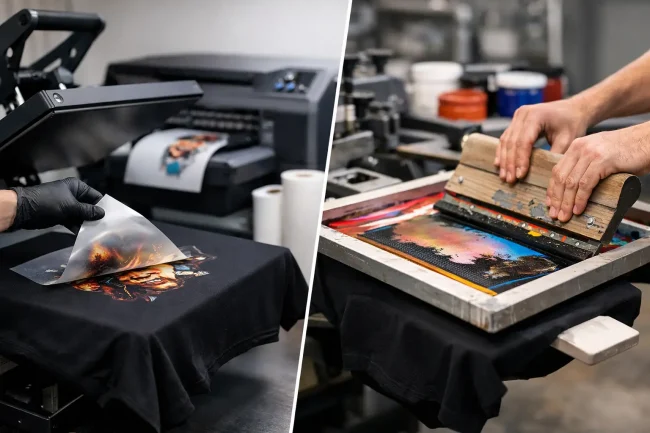
Screen printing is a traditional process that pushes ink through a mesh screen onto the garment. Each colour usually requires its own screen, setup and registration, which means preparation matters just as much as the print itself. When the artwork is simple and the run length is high, screen printing can be extremely efficient.
DTF, or Direct to Film, prints the design onto film, applies adhesive powder, cures it, and then transfers it to the garment with a heat press. It is well suited to detailed artwork, short runs and mixed orders because the process does not rely on separate screens for each colour. That changes the economics of production quite quickly.
The biggest operational difference is flexibility. Screen printing rewards repetition. DTF rewards variety. If your business handles changing artwork, personalised names, small batch orders or frequent reprints, that distinction matters more than any headline claim about print technology.
Where screen printing still makes strong commercial sense
Screen printing remains a very capable process, especially for established print shops running repeat work at volume. If you produce hundreds of garments with the same design, the setup time is spread across the order and the unit cost can become very attractive. For straightforward spot-colour jobs, it is still hard to ignore.
It also has a familiar workflow for many decorators. Teams with screen printing experience often know exactly how to manage inks, registration and production rhythms. In the right environment, that consistency can support reliable output day after day.
There are, however, conditions attached. Multi-colour artwork increases complexity. Short runs can become less efficient because setup takes time whether you print 10 garments or 500. Storage, wash-up, drying space and labour requirements also need to be considered properly. For a business with limited space or a lean team, those overheads are not always a minor detail.
Where DTF has changed the conversation
DTF has gained ground because it answers some of the most common pressures in modern garment decoration. Customers want shorter lead times, more colour detail, lower minimums and greater garment choice. DTF is well aligned with that demand.
A single workflow can handle complex logos, gradients, fine detail and photographic-style prints without the screen setup associated with traditional methods. That means one-off orders and small runs become much more commercially viable. You are not penalised in the same way for variety.
It is also a practical solution when you need to decorate different garment types within the same order. T-shirts, hoodies, workwear and bags can often be processed with far less disruption than a screen-based workflow would require. For many UK businesses, that translates into a more responsive service and fewer compromises at quotation stage.
This is where a proper production setup matters. DTF is not just a printer on a bench. Reliable output depends on the full system working together, from printer and powder application through to curing, pressing, consumables and operator training. Businesses that treat it as a complete workflow tend to get the best results.
Cost is not just about the print
When people compare dtf or screen printing, they often focus too narrowly on cost per print. That figure matters, but it does not tell the whole story.
Screen printing can offer a low unit cost on longer runs, but setup time, screen preparation, reclaiming, labour and waste all need to be factored in. If the job changes often, those costs can add up quickly. A shop that mostly produces repeat runs may accept that as part of an efficient model. A shop handling varied daily work may find it less forgiving.
DTF usually has a different cost profile. The per-transfer material cost may be more visible, but setup is lighter and artwork complexity has less impact on production time. That can improve profitability on small and mixed orders where screen printing would struggle to stay efficient.
The more useful question is not which process is cheapest in isolation. It is which process lets you complete the type of work you actually sell, at a margin that supports the business. There is a clear difference between theoretical cost and real commercial output.
Quality, feel and durability
Print quality should always be judged in context. Both screen printing and DTF can produce professional results, but they do so in different ways.
Screen printing is known for strong colour laydown and a familiar finish, particularly on bold graphics and simple branding. On the right garment and with the right ink system, it can look excellent and wear very well. It remains a trusted choice for many retail, promotional and uniform applications.
DTF offers impressive image detail, strong colour reproduction and consistent transfer quality when the process is properly controlled. It is especially effective for intricate artwork that would be cumbersome or inefficient to separate for screen printing. Fine text, tonal changes and complex logos are often easier to manage through DTF.
Feel can vary depending on artwork size, coverage and application. A small chest logo behaves differently from a large front print, regardless of method. Durability also depends on using the right consumables, maintaining the equipment correctly and applying transfers at the correct temperature, pressure and dwell time. In other words, the process matters, but so does the discipline behind it.
What suits start-ups and what suits established shops?
For start-ups, DTF often provides a more accessible route into professional garment decoration. It allows a business to take on varied work without building a full screen printing operation from day one. That can reduce barriers around space, setup complexity and order minimums.
It also gives newer businesses room to learn the commercial side of the market. You can serve schools, workwear clients, events, small brands and one-off custom orders without needing to funnel everything into long-run production logic.
For established print shops, the answer depends on current demand. If screen printing already serves your core volume work well, DTF may be less of a replacement and more of an expansion tool. It can help fill the gaps – short runs, urgent jobs, names and numbers, detailed artwork, test orders and low-volume repeat work.
That hybrid approach is increasingly common. The strongest operations are not always loyal to one method. They choose the method that protects efficiency and keeps quality high for each job type.
Support matters as much as the machinery
This is one area that gets overlooked too often. Buying equipment is only part of the decision. The bigger issue is whether you can keep production running consistently once the system is installed.
With DTF in particular, businesses benefit from proper demonstrations, installation guidance, training and after-sales support. That reduces costly trial and error and gives operators confidence in day-to-day production. A dependable supplier should be able to advise on the full setup, not just the printer itself.
That means understanding curing, pressing, film handling, consumable compatibility and maintenance routines. It also means having someone to call when output needs adjusting or when you want to scale up. DTF Magic® has built its reputation around that kind of complete support because commercial customers need more than a box delivered to the door.
Screen printing also relies on process knowledge, of course, but many businesses considering a move into DTF are doing so because they want a more flexible production model without sacrificing professional standards. In that situation, technical backup is not a nice extra. It is part of the investment.
So, should you choose DTF or screen printing?
If your workload is dominated by long runs of simple designs, and you already have the labour, space and production flow to support it, screen printing may remain the stronger fit. It is proven, efficient at volume and commercially sound in the right hands.
If your orders are shorter, more varied, more detailed or more time-sensitive, DTF is often the more practical choice. It gives businesses the ability to respond quickly, print complex designs and serve a broader range of customers without the same setup burden.
For many garment decorators, the answer is not ideological. It is operational. Choose the method that helps you quote confidently, produce reliably and grow without building avoidable bottlenecks into your workflow.
The best print system is the one that keeps your presses moving, your standards high and your customers coming back with the next order.