DTF Transfers Consumables
A DTF printer can look impressive on a spec sheet, but day-to-day output is usually decided by the consumables behind it. In commercial production, DTF Transfers Consumables are not just refill items – they are the parts of the process that determine print consistency, transfer feel, wash durability, machine reliability and, ultimately, whether a job leaves on time.
That matters whether you are setting up your first system or trying to scale an established garment decoration business. Cheap media and poorly matched supplies can make a capable printer perform badly. Well-chosen consumables, backed by proper guidance, do the opposite. They stabilise production, reduce waste and give you a more predictable route to profit.
Why dtf consumables matter more than many buyers expect
When businesses first look at Direct to Film, attention often goes straight to printer width, speed and headline pricing. Those are valid considerations, but they are only part of the picture. DTF is a production method built on interaction between components. Ink needs to sit correctly on the film. Powder needs to bond evenly. Curing needs to be controlled. Pressing needs to complete the transfer without scorching, under-curing or leaving inconsistent adhesion.
If one part of that chain is weak, the whole workflow feels it. Colours can shift, white ink can behave unpredictably, powder coverage can become patchy and finished transfers may fail sooner than expected. In a commercial setting, that is not just frustrating – it affects remake rates, turnaround times and customer confidence.
This is why experienced operators tend to assess consumables in terms of system performance rather than individual item cost. The cheapest bottle of ink or lowest-priced film roll is rarely the best value if it increases cleaning cycles, creates spoilage or leads to rejected garments.
The core DTF consumables in a working setup
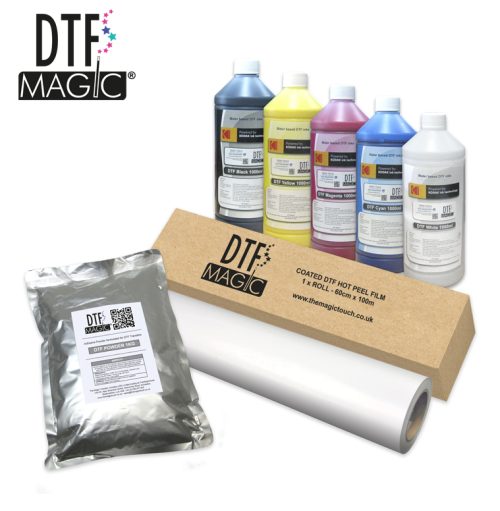
Most production environments will rely on the same essential consumables: film, inks, hot melt adhesive powder and cleaning or maintenance fluids. Each has a direct effect on output quality, and each should be selected with the rest of the setup in mind.
DTF film
Film does more than carry an image. It influences ink laydown, release behaviour, powder hold and handling through the printer and curing stage. Good film supports stable printing, clean detail and reliable transfer release. Poor film can lead to cockling, smudging, inconsistent coating response or awkward peeling.
The right option depends on your workflow. Some businesses prefer hot peel for faster handling, while others choose cold peel for a particular finish or production rhythm. Neither is automatically better. It depends on staff preference, order volume and the sort of garments being produced.
DTF inks
Ink performance is central to colour strength, opacity and printer health. White ink, in particular, is often where weaker systems reveal themselves. It needs proper circulation, stable formulation and a workflow that reduces settling and blockages. If white ink is unreliable, production reliability quickly suffers.
Consistent ink sets also help when repeat jobs matter. If you are printing branded work, uniform colour behaviour from one run to the next is not optional. It is part of delivering a professional service.
Adhesive powder
Powder is often underestimated, yet it has a major role in bond strength, wash performance and handle on the finished garment. Apply too little and adhesion can be weak. Apply too much and the transfer may feel heavy or look untidy around the edges.
Different powders can suit different finishes and operating conditions. The key is compatibility with your print process, curing method and target garment range.
Cleaning and maintenance fluids
These are not glamorous purchases, but they are essential. Reliable maintenance products support printhead care, keep ink systems cleaner and help reduce downtime. In a busy workshop, preventing a problem is usually far cheaper than pausing production to fix one.
Choosing DTF consumables for commercial reliability
The most sensible buying decision is not to ask which consumable is cheapest. It is to ask which combination gives the most dependable output over time. For growing businesses, reliability is often worth more than a modest saving on unit price.
A good starting point is compatibility. Consumables should be suited to the printer, curing process and press conditions you are actually using. Mixing products from multiple sources may appear flexible, but it can also create variables that are hard to diagnose. If print quality drops, it becomes more difficult to pinpoint whether the issue is ink chemistry, film coating, powder behaviour or machine setup.
Support is the second major factor. Businesses that buy consumables without technical backup often spend more time troubleshooting than printing. Commercial users benefit from working with a supplier that understands the full production chain and can advise on installation, operating conditions, maintenance routines and workflow adjustments. That is particularly valuable for start-ups, but established print shops also benefit when they are running tighter deadlines and larger order volumes.
Where businesses usually run into trouble
In many cases, quality problems are blamed on the printer when the real cause sits elsewhere. A transfer that cracks early may be linked to curing or powder choice. Colours that appear dull may stem from the film or ink profile. Frequent head maintenance might reflect poor white ink management, unsuitable environmental conditions or the wrong approach to shutdown procedures.
There is also the issue of inconsistent replenishment. Switching between consumable grades because one happens to be available at a lower price can disrupt a stable workflow. If a business has spent time getting press settings, curing temperatures and print profiles working well, introducing a different film or powder simply to trim cost can create more waste than it saves.
This is why consistency of supply matters almost as much as consistency of product. Commercial operators need to know they can reorder the same consumables, receive the same performance and keep jobs moving without re-testing the process every few weeks.
DTF consumables and the true cost of production
Consumable decisions affect margins in ways that are not always obvious at first glance. The purchase price is only one element. Waste, remake rates, maintenance time, machine downtime and labour all sit alongside it.
A lower-cost film that causes misfeeds or poor release can increase spoilage. Ink that needs more frequent intervention can reduce productive hours. Powder that gives variable adhesion can create complaints after garments have already left the building. Viewed that way, the true cost of consumables is measured in output reliability, not just invoice value.
For businesses quoting trade work or handling repeat customer orders, dependable DTF Transfers Consumables also support pricing confidence. If your process is stable, you can quote with a clearer understanding of yield, time and risk. That is a better commercial position than constantly building in contingency for materials that may or may not behave as expected.
Why a complete supply approach makes a difference
For many UK print businesses, the strongest setup is not built around buying isolated items from multiple sellers. It comes from using a supplier that understands the complete DTF ecosystem – printer, shaker, curing method, press equipment, ink circulation, DTF Transfers Consumables and operator training.
That joined-up approach reduces the guesswork. It also makes after-sales support far more useful, because advice can be based on the actual production environment rather than a partial view of it. If a business is expanding, adding capacity or bringing DTF in-house for the first time, that kind of support can shorten the learning curve and protect early investment.
This is where DTF Magic® reflects what serious production customers often need most: not simply a product catalogue, but practical guidance, setup support and ongoing help that keeps output commercially viable.
What to look for before you commit
If you are reviewing DTF Transfers Consumables for a new or existing setup, look beyond individual product claims. Ask whether the consumables are proven in a real production environment, whether they are supported by people who understand the equipment they run through, and whether supply will remain steady as your order volume grows.
Also consider the type of business you want to build. If your aim is occasional short-run work, your tolerance for testing and adjustment may be higher. If your model depends on repeatable quality, fast turnaround and minimal downtime, consumable choice becomes a strategic decision rather than a purchasing detail.
The strongest DTF operations are rarely the ones chasing the lowest line-item cost. They are the ones built on stable materials, sensible process control and supplier support that keeps production predictable when workloads increase.
The practical test is simple: choose consumables that help your team produce the same standard of transfer tomorrow, next month and during your busiest season – because that consistency is what customers remember.