When an urgent garment order lands on your desk, production bottlenecks show up quickly. That is where ready to press DTF transfers make commercial sense. Instead of printing, powdering, curing and testing every job in-house, you receive transfers prepared for application, allowing you to focus on pressing, finishing and dispatch.
For many UK print businesses, that is not a shortcut. It is a practical production choice. If your priority is consistent output, reliable turnaround and reduced waste, ready-made transfers can strengthen your workflow without forcing you into a full print setup before you are ready.
What ready to press DTF transfers actually are
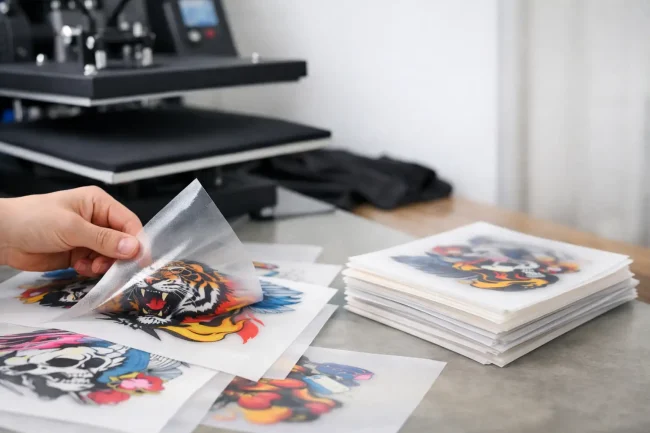
Ready to press DTF transfers are printed film transfers supplied in a finished state, prepared for heat application onto garments and other suitable textiles. The design has already been produced using DTF inks, adhesive powder and curing equipment, so the transfer arrives ready for the heat press rather than the printer.
That distinction matters. A lot of businesses want the benefits of DTF print quality but do not want to handle every stage of production from day one. Others already run a busy workshop and need overflow capacity without compromising finish. In both cases, ready to press DTF transfers provide access to the process without requiring every order to pass through your own print line.
This is especially useful where demand is uneven. One week might be dominated by small custom runs, while the next brings repeat orders with tight deadlines. Holding a dependable route to transfer supply gives you more flexibility than trying to build every job around your internal machine time.
Why businesses choose ready to press DTF transfers
The biggest advantage is speed. You remove several technical stages from the job and reduce the risk of delays caused by printer maintenance, curing issues or consumable shortages. If your team already understands heat pressing and garment handling, the learning curve is far lower than building a full DTF print operation from scratch.
There is also a clear commercial benefit. Printing in-house can absolutely be the right long-term move, but it comes with capital cost, training time, installation requirements and ongoing maintenance. For start-ups, that investment may be premature. For established decorators, it may be more sensible to reserve in-house equipment for specific production volumes while using prepared transfers for selected work.
Consistency is another reason businesses adopt this model. A properly produced transfer should apply cleanly, retain detail and deliver dependable adhesion when pressed to the correct specification. That consistency helps protect your reputation, particularly when you are handling customer orders under time pressure.
Where they fit best in a commercial workflow
Ready to press DTF transfers are particularly useful when your business needs flexibility. Short runs, test ranges, event merchandise, staff uniform updates and seasonal promotional work can all benefit from a process that avoids setup-heavy production.
They are also well suited to companies that already own a heat press but are not yet ready to invest in printers, shakers, curing units and the support systems around them. That middle ground is often overlooked. Not every business needs to go from zero to a full production line immediately.
For larger operators, prepared transfers can act as overflow support. If your in-house printer is at capacity, offline or allocated to higher-volume work, using supplied transfers keeps orders moving. In a commercial environment, continuity often matters more than doing every task under one roof.
The trade-off between convenience and control
There is no single right route for every business. Ready to press transfers are efficient, but they do involve giving up part of the production process to a supplier. That means your results depend not only on your pressing technique, but also on the quality of the transfer itself.
If you need constant same-day artwork changes, extremely specialised media testing or full control over every production variable, in-house print may suit you better. On the other hand, if your goal is dependable fulfilment with lower operational complexity, prepared transfers can be the stronger option.
This is why supplier quality matters so much. The transfer is only one part of the result, but it is the part you cannot correct once it arrives. Poor print density, inconsistent powder application or incomplete curing can all create problems at pressing stage. A dependable supply partner reduces that risk and gives you a more predictable workflow.
How to get the best results from ready to press DTF transfers
Application is straightforward, but commercial consistency still depends on process discipline. Heat press temperature, dwell time, pressure and fabric compatibility all need to be handled properly. Small variations can affect feel, adhesion and wash durability.
Your press must be delivering even heat across the platen. That sounds basic, yet uneven heat is one of the most common reasons for disappointing results. If one side of the press runs cooler, transfers may appear to apply correctly but fail prematurely in wear or washing.
Pressure matters just as much. Too little pressure can leave areas under-bonded. Too much can distort the transfer edge or affect the finish, depending on the garment and transfer specification. It is worth testing settings before moving into live production, especially when working with a new garment range.
Fabric choice also affects the outcome. DTF is versatile and works across a wide range of textiles, but not every substrate behaves the same way. Cotton, polyester and blends each respond slightly differently under heat and pressure. A transfer that performs beautifully on a ringspun cotton tee may need adjusted handling on performance wear or coated workwear.
What to check before ordering
Artwork quality should be your first consideration. No transfer process can rescue poor file preparation. If your artwork is low resolution, poorly separated or not sized correctly for the garment, the final result will reflect that.
You should also think about order pattern, not just order volume. Some businesses assume they need a full print setup because they expect to grow, but growth does not always mean immediate machine ownership. If your workload is mixed or irregular, ready-made transfers may be the more sensible way to scale until demand becomes stable enough to justify equipment investment.
Lead times are another practical factor. If your business promises fast turnaround, you need clarity on transfer supply times and pressing capacity. A reliable process depends on both. It is no use sourcing quality transfers if your own finishing stage becomes the new bottleneck.
Finally, consider support. Businesses often focus on price per print and overlook the cost of poor advice. Technical guidance, realistic application instruction and after-sales help can save far more than a marginally cheaper transfer source.
Ready to press DTF transfers versus in-house DTF printing
This is not a simple better-or-worse comparison. It depends on your business model.
If you are testing the market, adding garment decoration to an existing operation or managing modest order volumes, ready to press DTF transfers offer a lower-risk route into DTF output. You avoid major setup costs while still delivering a professional finish.
If you have sustained daily volume, frequent design changes and the staff capacity to manage print production, in-house DTF may deliver stronger margins over time. But those margins only hold if the system is installed correctly, maintained properly and supported by dependable training and consumable supply.
That is why many businesses move in stages. They start with supplied transfers, build customer demand, refine their garment workflow and then decide whether bringing print production in-house makes commercial sense. A company such as DTF Magic® can support that progression because the conversation is not limited to selling a single component. It is about building a workable production route.
Why support matters as much as the transfer
In real production, problems rarely arrive one at a time. A garment change, a press calibration issue and an urgent deadline can collide in the same afternoon. When that happens, technical support and practical advice are every bit as valuable as the product itself.
Businesses investing in DTF output need more than a box of consumables or a transfer sheet in the post. They need confidence that the process will remain dependable as order volumes change. That is particularly true for start-ups, but it matters just as much to established decorators protecting customer relationships and delivery schedules.
A service-led supplier helps you make the right decision for where your business is now, not where marketing claims say it should be. Sometimes that means starting with ready-made transfers. Sometimes it means moving towards a complete in-house setup. The right answer is the one that keeps your production reliable and commercially sound.
If you are weighing up your next step, think less about what looks impressive on paper and more about what keeps orders moving, quality consistent and customers returning. That is usually where the best production decisions begin.