If you print garments for paying customers, this question comes up quickly: can DTF print on cotton? The short answer is yes, and that is one of the main reasons DTF has become such a practical production method for modern garment decorators. DTF Transfers on Cotton is one of the most commonly ordered fabrics in workwear, fashion, events and promotional clothing, so any process that struggles on cotton creates limits straight away. DTF does not have that problem.
What matters is understanding that printing DTF Transfers on Cotton successfully is not just about whether the transfer will stick. It is about whether the finished print looks professional, feels commercially acceptable, washes well and can be repeated consistently across a production run. That is where the quality of the system, the consumables and the operator support make a real difference.
Can DTF print on cotton reliably?
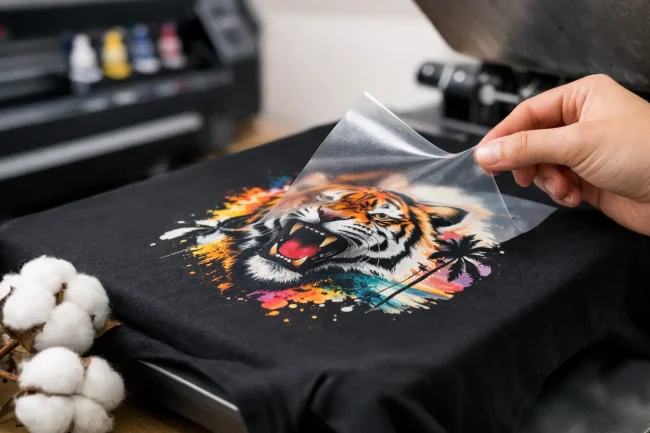
Yes, DTF can print on cotton reliably when the full process is controlled properly. The transfer is printed on film, coated with adhesive powder, cured, and then heat pressed onto the garment. Because the adhesive layer bonds to the cotton surface effectively, DTF works very well on cotton T-shirts, hoodies, sweatshirts, tote bags and a wide range of similar products.
For many businesses, that versatility is the real advantage. Traditional direct-to-garment printing has strengths on cotton, but it can require pre-treatment and may be less flexible across mixed fabric orders. DTF offers a simpler route when you need one transfer process that can handle DTF Transfers on Cotton as well as polyester, blends and other common garment types.
That said, “works on cotton” and “works well on cotton” are not always the same thing. A poor-quality film, unstable ink performance, inconsistent powder application or weak curing can all reduce adhesion and affect wash durability. If you are running a commercial operation, those details are not minor. They affect reprints, customer complaints and margin.
Why cotton is a strong fit for DTF printing
DTF Transfers on Cotton is popular because customers like the feel, breathability and familiar retail finish. From a decorator’s perspective, it is also a fabric that appears across nearly every market segment, from schoolwear and uniforms to branded merchandise and fashion drops.
DTF suits cotton because the transfer sits on the garment surface rather than relying on the fabric structure in the same way as some other print methods. That makes it easier to achieve bold colour, sharp detail and strong opacity, even on darker cotton garments. Fine text, logos and multi-colour artwork can reproduce very effectively if the transfer has been produced and applied correctly.
Another benefit is operational flexibility. If your business handles short runs, mixed garment types or custom orders, DTF lets you keep the decoration method consistent while changing the garment itself. That can simplify production planning and reduce the need for separate systems for separate fabric types.
What affects DTF results on cotton?
The fabric may be cotton, but the outcome depends on the entire production chain. In practice, DTF Transfers on Cotton is forgiving in many cases, but not so forgiving that poor process control goes unnoticed.
Transfer quality matters first
If the transfer is poorly printed, cotton will not hide it. Weak white ink coverage, poor detail definition or uneven powder distribution will show clearly on the finished garment. The transfer needs to be produced with stable ink laydown, good powder coverage and proper curing before it ever reaches the press.
This is why businesses moving into DTF should think beyond the printer alone. Reliable production depends on how the printer, powdering stage, curing process and heat press work together. A complete setup is usually more commercially sensible than trying to patch together separate elements and hoping they behave consistently.
Press settings matter more than many expect
Incorrect temperature, pressure or dwell time can lead to under-bonding, edge lift or reduced wash performance. Cotton garments also vary. A lightweight ringspun T-shirt does not always behave exactly like a heavy brushed hoodie, even when both are cotton.
That does not mean DTF is difficult. It means your press settings need to be tested properly and repeated consistently. In a business environment, repeatability is the goal. Once you have the right settings for your transfer and garment range, production becomes much more predictable.
Garment quality also plays a part
Not all cotton garments are equal. Surface texture, lint, moisture and finishing treatments can influence the pressed result. Lower-cost garments can still work well, but there may be more variation from batch to batch.
For decorators supplying retail or branded work, it makes sense to test on the exact garment range you plan to sell. That avoids unpleasant surprises when a sample looks good but the bulk order behaves differently.
How DTF on cotton compares with other print methods
For DTF Transfers on Cotton garments, the comparison usually comes back to DTG, screen print and heat transfer vinyl.
DTG can produce a soft hand feel and excellent photographic output on suitable cotton garments, but it often involves pre-treatment and more fabric-specific workflow considerations. Screen print remains strong for long runs and simple spot colour work, but setup time can make it less efficient for smaller or varied orders. Heat transfer vinyl has a place for names, numbers and certain graphics, though it is less suited to detailed, full-colour artwork at scale.
DTF sits in a very useful middle ground. It handles cotton well, supports full-colour artwork, works across multiple fabric types and suits on-demand or short-run production. For many businesses, that combination is what makes it commercially attractive.
The trade-off is that your process discipline needs to be good. DTF is not a licence to ignore curing, storage, press performance or maintenance. Like any serious decoration method, it rewards the operators who treat it as a production system rather than a shortcut.
Can DTF print on cotton and still last in the wash?
Yes, provided the transfer has been made and applied correctly. Wash durability is one of the most important questions for any cotton garment because these items are often worn frequently and washed regularly.
A properly produced DTF transfer on cotton should retain colour, adhesion and definition well through repeated washes. Problems usually trace back to process issues rather than cotton itself. Under-cured powder, incorrect press settings, poor-quality consumables or contaminated garment surfaces are more likely to cause failure than the fact the garment is made from cotton.
For commercial decorators, the sensible approach is straightforward: test, record and standardise. Run wash tests on your core garments, confirm your press settings and keep your production method consistent. That gives you confidence when customer orders increase.
Best practice for printing DTF on cotton
If you want dependable results on cotton, the most effective route is not guesswork. It is using a matched system, quality consumables and proper training.
Start with stable transfer production. The print, powder and curing stages must be controlled so the adhesive layer is ready to bond cleanly. Then make sure the cotton garment is prepared correctly at the press. A quick pre-press helps remove moisture and flatten the print area, which can improve consistency.
After that, accuracy matters. Apply the transfer with the correct temperature, pressure and dwell time for the material and transfer specification. Follow the peel instructions carefully, whether hot, warm or cold peel, and if a finishing press is recommended, do not skip it. Small shortcuts often become expensive when garments come back.
For growing businesses, this is exactly where supplier support matters. Equipment supply on its own is only part of the picture. Installation guidance, demonstrations, operator training and ongoing technical help can save a great deal of wasted stock and downtime. That is why many commercial users prefer to work with specialist partners such as DTF Magic® rather than buying purely on headline price.
When cotton results may need extra attention
There are some cases where cotton printing needs a more careful approach. Heavy seams, textured garments, very lightweight fabrics and certain finished or treated cotton products can all affect the final result. Large solid designs may feel more substantial on the garment than softer print methods, particularly on lightweight cotton tees.
That does not make DTF the wrong choice. It simply means artwork, garment selection and customer expectations should be aligned. If a customer wants maximum softness on a fashion tee, you may discuss design size or print method. If they want bold branding, strong opacity and broad fabric compatibility, DTF is often an excellent fit.
Commercially, the key is choosing the method that suits the job rather than forcing every order through the same process. DTF gives you a very strong option for cotton, but good production decisions still depend on the garment, the artwork and the end use.
Cotton is not a problem fabric for DTF. In many print environments, it is one of the reasons businesses invest in DTF in the first place. When the equipment is dependable, the consumables are consistent and the process is properly supported, cotton garments can deliver the kind of professional result that keeps orders moving and customers coming back.