DTF Transfers Printer Maintenance
A DTF printer rarely fails without warning. More often, print quality starts to drift, white ink behaves unpredictably, or a routine job takes longer than it should because the machine has not been kept in a stable working condition. For any business relying on transfer output, DTF Transfers Printer Maintenance is not just a technical task. It is part of protecting turnaround times, reducing waste and keeping production dependable.
DTF equipment rewards consistency. The shops that get the best results are not always the ones with the most complex setup, but the ones with disciplined maintenance habits. Good upkeep supports nozzle health, stable ink flow, better adhesion and fewer interruptions during busy periods. It also helps operators spot small issues before they become expensive ones.
Why maintenance matters in commercial DTF production
DTF printing is a production process, not a casual desktop activity. You are managing ink chemistry, heat, film movement and mechanical accuracy in one workflow. If one part of that chain starts to drift, the effect shows up quickly in rejected prints, poor transfer feel or unnecessary downtime.
White ink is usually the biggest maintenance pressure point. Because it contains heavier pigment, it settles more readily than colour ink and demands more attention. If circulation is poor, if the printer sits unused for too long, or if environmental conditions fluctuate, you can see blocked nozzles, uneven density and weak opacity. That is why maintenance is not only about cleaning. It is about controlling the conditions that keep the system stable.
There is also a commercial trade-off to consider. Some operators try to minimise maintenance to save time, but that often leads to more lost time later. Equally, over-cleaning can waste ink and place unnecessary strain on components. The right approach is routine, measured care based on actual machine use, local conditions and manufacturer guidance.
How to maintain DTF printer day to day
Daily maintenance should be simple enough to become part of opening and closing procedures. If it feels complicated, it usually will not be done consistently.
At the start of the day, check the printer environment first. Temperature and humidity matter more than many new operators expect. A room that is too cold, too dry or subject to sudden swings can affect ink behaviour and printhead condition. Stable operating conditions support stable output, especially with white ink.
Run a nozzle check before committing film and ink to production. This gives you an immediate view of printhead health and can help you decide whether the machine is ready to print, needs a light clean or should be left alone. Many problems become worse when operators push ahead despite an imperfect nozzle pattern.
The capping station, wiper and surrounding area should also be inspected daily. Ink build-up in these areas can interfere with proper sealing and cleaning. If the cap top does not seal correctly, the printhead can dry out more quickly. If the wiper is contaminated, it may smear rather than clean. A few moments spent keeping these parts tidy can prevent recurring faults.
At the end of the shift, leave the printer in the correct parked condition according to the machine’s operating procedure. This sounds basic, but it is one of the most common areas where standards slip. A printer left improperly parked is far more likely to develop nozzle issues by the next morning.
Weekly checks that prevent bigger faults
Daily care keeps the machine operating. Weekly checks help keep it efficient.
This is the right time to inspect ink lines, dampers and circulation performance, especially on systems using white ink management features. Look for signs of sediment, air ingress or inconsistent flow. If white ink is not being kept in motion as intended, blockages can follow even when daily cleaning appears to be done correctly.
It is also worth checking for dust and powder contamination around the printer. In a busy garment decoration environment, powder and general workshop debris can travel further than expected. If they settle in sensitive areas, they can affect sensors, rails and moving parts. The answer is not to turn the print room into a laboratory, but to keep a clean, well-managed production area.
Film feed and alignment should be reviewed as part of weekly maintenance too. If tracking is inconsistent or media handling begins to drift, it may not be an ink issue at all. Mechanical checks matter just as much as printhead care. A printer can have perfect nozzles and still produce poor commercial output if the film is not feeding cleanly.
Printhead care without causing avoidable damage
Printheads are one of the most valuable and sensitive parts of any DTF printer, so DTF Transfers Printer Maintenance must be careful rather than aggressive. Operators sometimes make matters worse by cleaning too forcefully or too often.
The key is to respond to symptoms in proportion. A minor nozzle loss may only need a controlled cleaning cycle and a short wait before another check. Repeated heavy cleaning cycles can consume ink and stress the system without solving the real cause. If the issue is environmental, related to poor parking, or linked to white ink settling, aggressive cleaning is only masking it.
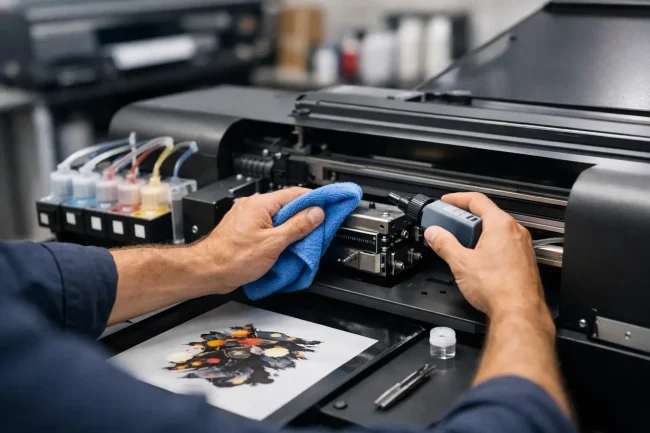
Manual cleaning has its place, but only when done correctly and with appropriate materials. Using unsuitable cloths, excessive pressure or the wrong fluid can damage delicate surfaces. This is one reason proper installation and operator training matter so much. A business that understands when not to interfere often avoids more faults than one that is constantly trying to fix the printer mid-shift.
Consumables and environment are part of maintenance
A DTF printer does not operate in isolation from its consumables. Ink quality, film consistency and powder handling all influence maintenance demands.
Poorly stored ink can behave unpredictably. Film with inconsistent coating can make operators think there is a printer problem when the fault lies elsewhere. Powder contamination near the printer can create cleaning issues that seem mechanical at first glance. If you want to know how to maintain DTF printer reliability over time, look beyond the machine itself and assess the whole workflow.
Storage conditions matter here. Consumables should be kept in stable conditions and rotated sensibly so older stock is used in sequence. It also helps to avoid mixing products without a clear reason, particularly if a system has been set up and profiled around specific materials. Consistency across the workflow generally makes maintenance simpler.
What to do when the printer is used less often
Not every business runs high-volume DTF production every day. Some print shops use DTF as one service among several, which means there may be quieter periods. Lower usage creates its own maintenance challenge because printers that sit idle are more vulnerable to ink settlement and nozzle drying.
If your machine is not printing daily, your maintenance schedule needs to reflect that. Circulation systems, periodic checks and controlled test output become more important. Leaving a DTF printer untouched for several days and expecting it to perform instantly is rarely realistic, especially where white ink is involved.
This is where supplier support has real value. The right routine can vary by printer model, ink set, room conditions and actual production pattern. A start-up with intermittent orders may need a different approach from a busy transfer producer running all week. What matters is having a clear plan rather than relying on guesswork.
Building a maintenance routine your team will follow
DTF Transfers Printer Maintenance is the one thing your team can apply consistently under production pressure. If responsibilities are vague, tasks get skipped. If procedures are overly complex, they are rushed.
A practical routine usually includes start-of-day checks, end-of-day parking and cleaning, weekly inspections and a clear process for escalation when print quality changes. Keep records if more than one operator uses the machine. That way, recurring issues can be tracked properly rather than passed between shifts with no context.
For growing businesses, maintenance should be treated as part of output planning, not an interruption to it. The small amount of time set aside for proper care is usually far less costly than reprints, missed dispatch deadlines or damaged components. That is why DTF Magic places so much emphasis on training, setup guidance and after-sales support. Reliable output starts with reliable habits.
If you approach maintenance as part of commercial discipline rather than a last-minute fix, your printer is far more likely to deliver the consistency your customers expect.