If you are weighing up new print methods or trying to improve production without adding unnecessary complexity. DTF Transfers Explained Clearly is the right place to start. Direct to Film has grown quickly because it solves a practical problem for garment decorators. Producing vibrant, durable transfers that work across a wide range of fabrics without the setup demands of some traditional methods.
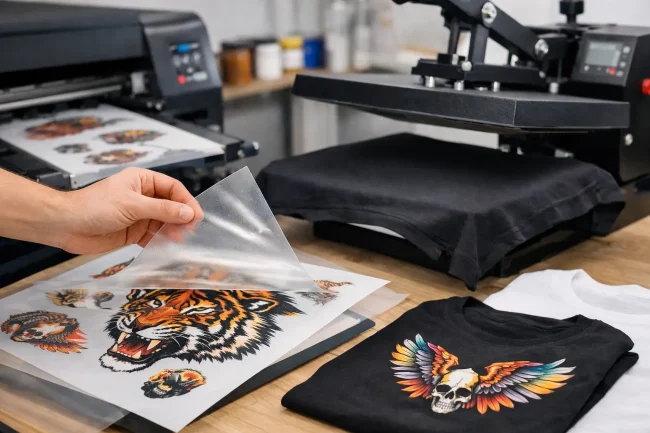
At its simplest, DTF printing involves printing a design onto a specialist film using DTF inks. Then applying adhesive powder, curing that powder, and then pressing the finished transfer onto the garment. That sounds straightforward, but the commercial value comes from consistency. When the process is properly set up, DTF gives businesses a dependable way to handle short runs, mixed garment types and detailed artwork without constantly changing approach from one job to the next.
What DTF transfers are and why they matter
A DTF transfer is a printed image carried on film, coated with hot-melt adhesive and prepared for heat application. Once pressed onto the garment, the design bonds to the fabric surface with strong colour hold and good wash durability.
For a production business, that matters because flexibility has a direct impact on profitability. Cotton, polyester, blends and many other textiles can all be decorated with DTF. That reduces the number of jobs you need to turn away or re-route through a different process. It also helps when customers want varied garment types within one order, which is increasingly common in workwear, branded clothing and promotional products.
DTF Transfers Explained Clearly: how the process works
The process starts with artwork preparation and print output. A DTF printer lays down colour and white ink onto PET film in the correct sequence. Adhesive powder is then applied to the wet ink layer, and the sheet is cured so the powder melts and forms a stable adhesive backing.
After that, the transfer is ready for application with a heat press. The operator places the transfer onto the garment, presses it at the required temperature and dwell time, then peels the film according to the product specification. In many cases a final repress improves finish and handle.
That is the mechanical explanation, but from an operational point of view, each stage has to be controlled properly. Ink circulation, humidity, curing temperature, film quality and press accuracy all affect the final result. Businesses that treat DTF as a complete production system rather than just a printer purchase usually get better reliability and less waste.
Where DTF fits in a commercial workflow
DTF is often compared with screen print transfers, vinyl and DTG, but it is not simply a replacement for every other method. Its strength is versatility. It is particularly useful for short to medium runs, on-demand production, high-detail graphics, names and numbers, and jobs involving multiple fabric types.
There are trade-offs. Very high-volume repeat work may still favour other methods depending on margins and setup. Likewise, the finish of a DTF print is different from a direct-to-garment result, so customer expectation matters. The right question is not whether DTF replaces everything, but whether it improves your workflow, widens your offering and protects your turnaround times.
For many UK print businesses, the answer is yes – especially when they need a process that scales from startup production to more established commercial output.
What affects transfer quality most
Print quality is only one part of the result. Poor adhesive application, uneven curing or an inconsistent heat press can undermine a good design very quickly. This is why equipment choice matters beyond headline specifications.
Stable ink delivery helps prevent blockages and colour inconsistency. Reliable curing ensures the powder is melted correctly without scorching or under-curing. A good heat press provides even pressure and accurate temperature across the platen. If any of those elements are weak, the transfer may look acceptable at first but fail in wear, wash performance or repeatability.
Consumables matter just as much. Film, powder and ink need to work together as a system. Mixing products to save a small amount on cost can create bigger problems in production, including unpredictable adhesion and rework.
Choosing between printed transfers and a full DTF setup
Not every business needs to bring production in-house immediately. Some are better served by ordering ready-to-press DTF transfers while demand builds. That can be a sensible route if you want to test markets, add garment decoration capacity quickly or avoid capital investment at the outset.
For others, bringing DTF in-house gives better control over lead times, margins and production scheduling. If you are handling regular orders, custom work or fast-turnaround jobs, owning the full setup may make stronger commercial sense. The key is to assess real order volume, staffing, available space and your willingness to manage production daily.
This is where practical support becomes important. Installation, training and after-sales guidance reduce costly trial and error. Businesses investing in DTF equipment need more than a box delivered to the door – they need a working process that performs under commercial pressure. That is why many choose specialist suppliers such as DTF Magic®, where the focus is on complete production capability rather than isolated product sales.
What to ask before you invest
Before committing, be clear on the garments you decorate most, the volume you expect, and whether you need sheet-fed transfers, roll production or both. Consider maintenance requirements, operator training and how quickly you need the system to become revenue-generating.
Most importantly, ask what support exists after installation. Machines are only part of the equation. If your business depends on reliable output, technical backup and consumable consistency are not extras – they are part of the investment.
DTF works best when it is treated as a production method, not a shortcut. With the right setup and support, it can become one of the most adaptable and commercially useful processes in a modern print business.