How do dtf printers work in production?
If you are comparing print methods for garments, the real question is not just how do DTF printers work, but whether the process will give you dependable, repeatable output in a live production environment. For most businesses, that means understanding what happens between the artwork file and the finished pressed transfer, and where quality can be won or lost.
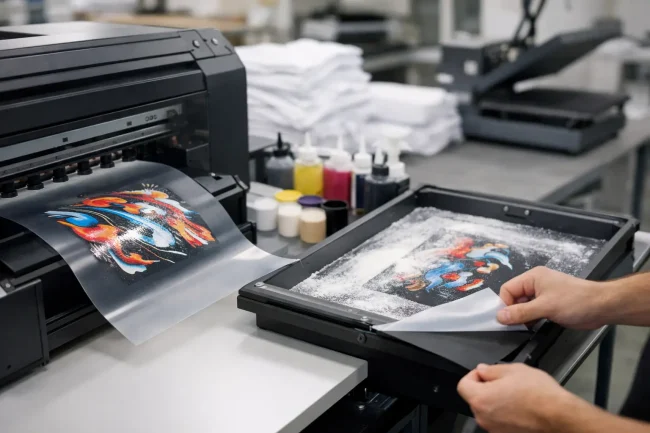
DTF, or Direct to Film, is a transfer-based printing process. Instead of printing directly onto the garment, the printer lays down the design onto a specialist PET film using DTF inks. A hot-melt adhesive powder is then applied to the wet ink, cured, and later transferred onto the fabric with a heat press. That sequence sounds straightforward, but each stage plays a direct role in print feel, wash durability, colour strength and workflow efficiency.
How do DTF printers work step by step?
At its core, a DTF printer works by producing a transfer rather than a finished garment. The design is printed in reverse onto film, usually with CMYK colours followed by a white ink layer. That white layer matters because it creates opacity and allows the design to sit clearly on dark and coloured fabrics.
Once printed, the film passes to the powdering stage. Adhesive powder is applied across the printed area and sticks to the wet ink. Excess powder is removed, leaving adhesive only where the image has been printed. The transfer is then cured so the powder melts and bonds correctly to the ink layer.
After curing, the transfer is ready for application. Using a heat press, the operator places the film onto the garment and applies the required temperature, pressure and dwell time. When handled properly, the result is a durable, flexible print that can work across cotton, polyester, blends and many other textile surfaces.
The main parts of a DTF printing system
Understanding the process is easier when you break it into equipment and consumables. A working DTF setup is not just a printer on its own. It is a production system, and reliability usually depends on how well those parts work together.
The printer
The printer deposits the ink onto the film with controlled precision. In commercial use, printhead quality, ink circulation and media handling all matter. If any of those are inconsistent, you can see banding, poor white coverage, inaccurate detail or interruptions in production.
For businesses, this is where buying on headline price alone can become expensive. A machine may appear competitive at first, but if it lacks stable white ink management or dependable technical backup, downtime can quickly outweigh any initial saving.
The film
DTF film is the carrier for the design until it is pressed onto the garment. Good film gives predictable ink laydown, releases properly after pressing and supports fine detail. Poor-quality film can cause issues with static, uneven coating or unreliable peel behaviour.
That matters more than many first-time buyers expect. A transfer process is only as stable as the consumables running through it every day.
The ink
DTF inks are formulated for this specific transfer process. The colour inks create the visible image, while white ink builds the backing layer that gives the print strength and opacity on fabric. White ink is particularly important, and it is also the part of the system that needs the most care because it contains heavier pigment that can settle if not managed correctly.
This is why ink stirring and circulation are often part of a serious production setup rather than an optional extra. If white ink is not kept in proper condition, print quality and printhead performance can suffer.
The adhesive powder and curing stage
The powder is what allows the printed image to bond to the fabric. It is not simply sprinkled on as a final touch. It is a functional part of the transfer, and the application must be even and correctly cured.
Under-cured powder can affect adhesion and wash performance. Over-curing can affect the feel and flexibility of the print. In practice, this is one of the reasons many businesses prefer a complete, matched setup rather than trying to piece together equipment from multiple sources.
The heat press
The heat press completes the job. Temperature, pressure and timing all need to be right for the transfer material, fabric type and production requirements. If the press is inconsistent, even a well-made transfer can produce disappointing results.
For commercial users, the press is not an afterthought. It is part of the quality-control chain.
What happens from artwork to finished garment?
The workflow usually begins with artwork preparation in RIP software. This software controls how the file is printed, including colour handling, white ink generation and print order. In most DTF workflows, the design is mirrored before printing because it will be flipped onto the garment during pressing.
The printer then outputs the image to film, typically with colour first and white behind it. While the ink is still wet, powder is applied so it adheres to the printed areas. The transfer is then cured until the adhesive reaches the correct state for pressing or storage.
At that point, the transfer can often be used immediately or held for later application. That flexibility is one reason DTF appeals to garment decorators and trade printers. You can produce transfers in batches, then press them onto garments as orders are confirmed. For many businesses, that helps manage labour, stock holding and turnaround times more efficiently.
Why businesses use DTF instead of other print methods
DTF has grown quickly because it solves several practical production problems. It allows full-colour image transfer without weeding, works across a wide range of fabrics and supports short runs as well as scalable output. For start-ups, it can provide an accessible route into garment decoration. For established print shops, it can add flexibility where existing methods have limitations.
That said, it is not a magic fix for every workflow. If you specialise in very high-volume single-colour work, other methods may still be more cost-effective for certain jobs. If you only print onto specific substrates, you may already have a process that remains the better fit. The value of DTF depends on what you produce, how varied your order profile is, and how important versatility is to your business.
Where quality issues usually start
When people ask how do DTF printers work, they are often really asking why some results look excellent and others do not. In most cases, the answer comes down to control.
Artwork quality matters, but so do printer settings, ink condition, powder application, curing accuracy and pressing technique. Problems such as dull colour, poor stretch, weak wash resistance or patchy adhesion are rarely caused by a single factor alone. More often, they come from a setup that has not been properly matched, installed or supported.
This is why training and after-sales guidance have genuine commercial value. A business can lose time and margin very quickly if staff are left to learn critical production variables through trial and error.
What to look for in a commercial DTF setup
If you are considering DTF for business use, the key question is not only whether the printer can print. It is whether the full system can support your expected workload with consistent output. That includes the printer, curing method, heat press, ink management, consumables and technical support behind them.
A complete setup should help you produce reliable transfers day after day, not just during a demonstration. Installation, training and ongoing guidance are especially important if you are new to DTF or scaling up from a smaller operation. This is where an experienced supplier becomes more than a product source. DTF Magic® takes that wider view because most businesses do not need a box delivered to the door – they need a working production solution they can depend on.
How do DTF printers work for long-term profitability?
The short answer is that they work best when process control is treated as part of the investment. A DTF printer earns its place by helping you produce saleable output consistently, keep waste low, and handle a wider range of jobs without unnecessary setup delays.
That means the real return does not come from the printer alone. It comes from a stable workflow, suitable consumables, trained operators and support when issues arise. For growing garment decorators, that is often the difference between adding a profitable service and adding another source of avoidable downtime.
If you are evaluating DTF for your business, focus on the whole production chain rather than the print engine in isolation. The businesses that get the best results are usually the ones that choose systems built for dependable daily use, then give the process the attention it deserves.