what is dtf printing vs vinyl?
If you are weighing up a new garment decoration method, the question is rarely academic. What is DTF printing vs vinyl becomes a practical decision about margins, turnaround times, labour, and the kind of orders your business can take on with confidence.
Both methods can produce strong commercial results. The better option depends on what you print, how often you print, and whether your priority is flexibility, speed, low entry cost, or scalable production. For some businesses, vinyl remains a useful part of the mix. For others, DTF changes what is commercially possible.
What is DTF printing vs vinyl in simple terms?
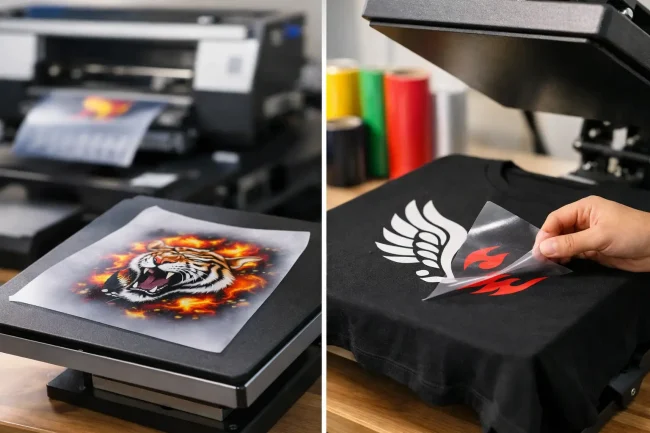
DTF printing, or Direct to Film printing, involves printing a design onto a special film, applying adhesive powder, curing it, and then heat pressing the transfer onto a garment or other suitable substrate. It is especially valued for full-colour work, fine detail, and the ability to apply transfers to a wide range of fabrics.
Vinyl decoration usually refers to heat transfer vinyl, often shortened to HTV. The design is cut from coloured vinyl using a cutter, excess material is weeded away by hand, and the remaining shape is heat pressed onto the garment. It is a well-established method and works particularly well for bold, simple graphics, names, numbers, and one or two-colour jobs.
That difference in process shapes almost everything else. DTF is a print workflow. Vinyl is a cut-and-press workflow.
Where DTF has the clear advantage
For many commercial print businesses, the main strength of DTF is freedom. You are not restricted to block shapes or single-colour layers. You can reproduce gradients, photographic elements, small text, and complex logos without turning the job into a time-heavy manual process.
This matters when customers submit artwork that looks straightforward on screen but would be awkward in vinyl. Multi-colour branding, tonal effects, and fine line detail are all far better suited to DTF. If your order book includes mixed garment types, shorter lead times, and varied artwork quality, DTF generally gives you more room to work efficiently.
It also helps with fabric compatibility. DTF transfers can be applied to cotton, polyester, blends, and many performance fabrics. Vinyl can also work across various garments, but the range of specialist vinyls needed to cover different finishes and applications can complicate stockholding. With DTF, one transfer system can often support a broader production mix.
Another practical advantage is repeatability. Once your workflow is set correctly, DTF can provide consistent transfers at scale. For businesses moving beyond occasional custom jobs into regular production, that consistency becomes commercially significant.
Where vinyl still makes sense
Vinyl is not obsolete, and it would be a mistake to present it that way. It remains a sensible choice in the right setting.
If you mainly produce simple lettering, school leavers’ hoodies, sports names and numbers, or straightforward logo placements in limited colours, vinyl can still be effective. The initial setup cost is usually lower than a full DTF production system, which makes it attractive to smaller operators or businesses testing demand.
Vinyl can also suit very low-volume work where one-off personalisation is the priority and the design is simple. A short name across the back of a shirt may be quicker to cut and press than preparing a transfer workflow, particularly if you already have the cutter in place and the material on the shelf.
There is also the finish to consider. Some customers like the crisp, solid appearance of vinyl for specific applications. In workwear, teamwear, or signage-related garment branding, that can still be a perfectly acceptable and commercially viable result.
Print quality and feel on the garment
what is dtf printing vs vinyl? This is often where buyers begin to see the difference clearly.
DTF is usually the stronger option when image quality matters. It handles detail, colour transitions, and complex artwork far better than vinyl because the image is printed rather than cut from solid-colour material. For fashion graphics, promotional apparel, and branded merchandise where visual accuracy counts, DTF gives you a more capable platform.
Vinyl is more limited by design. It creates clean edges and solid colour areas, but intricate artwork can become difficult to weed, align, and layer. The more complex the job, the more labour is introduced and the more risk there is of inconsistency.
In terms of feel, it depends on the transfer and application settings. A well-produced DTF transfer can feel soft and flexible, especially compared with heavier layered vinyl designs. Vinyl can feel thicker on the garment, particularly where larger coverage areas are involved. That is not always a problem, but it can affect wear comfort and customer perception on premium garments.
Durability and wash performance
Both methods can perform well if materials, pressing conditions, and garment choice are right. Poor settings will undermine either one.
DTF has built a strong reputation for wash durability and stretch when produced correctly. Commercial users value it because it can maintain image integrity across a wide range of garments without the cracking or lifting issues associated with poor application. The key phrase is produced correctly. Reliable ink, powder, curing, and heat press control matter.
Vinyl can also be durable, especially on simple applications with quality material. However, heavier designs or layered setups may become more vulnerable over time depending on washing conditions and garment movement. It is often dependable for straightforward jobs, but less forgiving as complexity increases.
For businesses, this is less about marketing claims and more about process control. Durability comes from using the right system and applying it consistently.
Labour, speed, and workflow efficiency
This is where the commercial case becomes clearer.
Vinyl often looks simple at first because the equipment entry point is lower. But labour can build quickly. Cutting, weeding, sorting, and aligning layers all take time. On a small number of garments, that may be manageable. On larger runs or complex designs, it becomes a bottleneck.
DTF shifts more of the work into the production system. Once transfers are printed and cured, application is straightforward. You remove much of the manual artwork handling that slows vinyl production down. This can make a major difference for businesses that need to process more jobs without increasing labour at the same rate.
That does not mean DTF is effortless. A proper setup includes printer management, powder application, curing, humidity awareness, and press discipline. But it is a production method that supports scale more effectively than manual vinyl workflows.
For growing businesses, that distinction matters. The cheaper workflow is not always the more profitable one if it limits capacity.
Setup cost and ongoing investment
If you are asking what is DTF printing vs vinyl from an investment point of view, vinyl usually wins on entry cost. A cutter, heat press, and rolls of vinyl are often enough to get started.
DTF requires more infrastructure. Depending on your setup, that may include the printer, curing solution, heat press, consumables, and space to operate properly. There is also the question of training and technical support, which should not be treated as optional if you want stable output.
That higher starting cost is real, but so is the difference in capability. DTF is generally a stronger choice for businesses aiming to produce full-colour transfers consistently, take on broader artwork requirements, and build a scalable production environment.
The more useful question is not which method is cheaper to buy. It is which method supports the kind of business you want to run six or twelve months from now.
Which method is right for your business?
If your work is mainly simple text, numbers, and low-volume personalisation, vinyl may still be a sensible and profitable option. It is familiar, accessible, and effective within its lane.
If your customers expect full-colour prints, detailed logos, soft-feel transfers, and faster handling of varied artwork across multiple garment types, DTF is usually the stronger commercial fit. It gives you broader capability, more consistent production potential, and fewer design limitations.
For many print shops, the decision is not about whether vinyl has value. It is about whether vinyl is enough. Once order complexity increases, labour becomes harder to control, and customers want more visual detail, DTF often stops being a nice addition and starts becoming the more practical production route.
That is why support matters as much as equipment. A dependable DTF setup is not just a printer in a box. It is training, installation, consumables that work together, and technical guidance when production needs to keep moving. For businesses that want to reduce guesswork and build a reliable workflow, that joined-up approach is often what turns investment into output.
The right choice is the one that matches your order profile, your growth plans, and the standard of finish your customers expect. If you are making that move carefully, a well-supported DTF system can give your business far more room to grow than a workflow built around cutting and weeding alone.