What Is DTF Printing vs Sublimation?
A lot of print businesses ask the same question just before investing in new equipment: what is DTF printing vs sublimation, and which one makes better commercial sense? The answer is not simply about print quality. It comes down to the garments you want to decorate, the finish your customers expect, and how much flexibility you need from your production setup.
If you are running a garment decoration business, adding a new print method affects far more than the machine itself. It shapes your workflow, your stock choices, your training requirements, and your ability to say yes to profitable work. That is why it helps to compare DTF and sublimation in practical terms rather than treating them as interchangeable technologies.
What is DTF printing vs sublimation in simple terms?
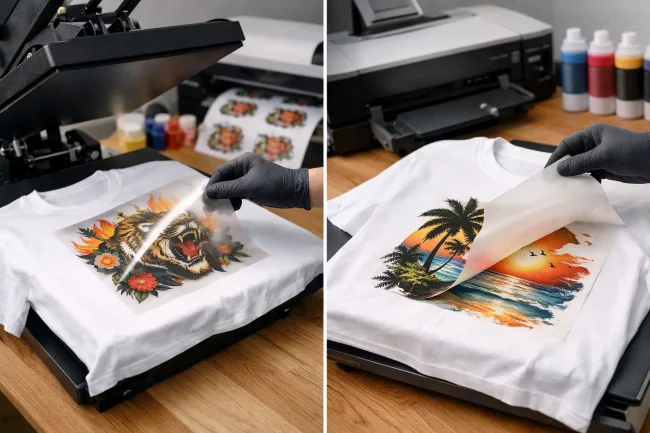
DTF stands for Direct to Film. The design is printed onto a specialist film using DTF inks, coated with adhesive powder, cured, and then heat pressed onto the garment or item. The print sits on the surface of the material as a bonded transfer, which gives DTF its wide fabric compatibility.
Sublimation works very differently. The design is printed onto sublimation paper with sublimation inks, then heat and pressure turn the ink into gas so it bonds into the polyester fibres or polymer-coated surface. Rather than sitting on top, the print becomes part of the substrate.
That difference is the starting point for almost every commercial decision between the two. DTF is valued for versatility. Sublimation is valued for a soft finish and strong performance on the right materials.
The biggest difference is what you can print onto
For most businesses, the first and most important distinction is substrate compatibility.
DTF can be applied to a wide range of garments and textiles, including cotton, polyester, poly-cotton blends, and many treated workwear or fashion items. That makes it attractive for print shops serving mixed customer demand. If one client wants cotton hoodies, another wants polyester sportswear, and another wants branded tote bags, DTF gives you far more freedom to handle all three without changing print technology.
Sublimation is much more selective. It works best on white or very light polyester garments, and on hard surfaces that carry a suitable polyester coating. If you are decorating mugs, panels, sports tops, and promotional items designed specifically for sublimation, it can be an excellent solution. If your customers regularly request cotton T-shirts or dark garments, sublimation becomes restrictive very quickly.
This is often where the comparison is decided. Businesses that need broad garment compatibility usually lean towards DTF. Businesses focused on polyester performance wear or coated giftware often find sublimation fits their model better.
Print finish and feel are not the same
The next question is usually about how the print looks and feels in use.
Sublimation is known for producing an extremely soft finish because the ink dyes the fibres rather than forming a layer on top. On the correct polyester substrate, the result can look bright, clean, and almost weightless to the touch. For all-over sports garments, fashion polyester, and hard promotional products, that is a real advantage.
DTF produces a transfer layer on the garment surface. A well-produced DTF transfer can still look sharp, vibrant, and highly professional, but the hand feel is different. On logos, chest prints, left-breast branding, workwear graphics, and many retail-style designs, that is rarely a problem. In fact, for many commercial jobs, customers care more about colour strength, durability, and being able to print onto the garment they actually want.
So the better finish depends on the application. If your priority is the softest possible print on polyester, sublimation has an edge. If your priority is applying detailed, full-colour artwork across varied garment types, DTF is usually the more practical choice.
Colour performance and design flexibility
Both methods can produce strong colour, but they do so under different conditions.
Sublimation performs best on white or pale polyester because the ink becomes part of the fabric and there is no white ink layer beneath the design. On bright white polyester, colours can appear very vivid. On dark garments, standard sublimation simply does not deliver because there is no practical white base to support the image.
DTF has a major advantage here because it uses white ink as part of the transfer process. That means you can apply full-colour graphics to black, navy, red, grey, and other dark garments with excellent visibility. For businesses handling branded workwear, schoolwear, event clothing, and retail graphics, that flexibility matters every day.
Fine detail is another strength of DTF when the setup and process are managed correctly. Small text, multi-colour logos, and intricate graphic elements can reproduce very well, which is one reason the method has gained so much traction in commercial garment decoration.
Production workflow and day-to-day operation
What is dtf printing vs sublimation. When businesses compare technologies, they sometimes focus too much on the headline machine price and not enough on how production actually runs.
Sublimation has a relatively straightforward workflow. Print onto paper, position the transfer, heat press, and remove. For suitable products and repeatable jobs, it can be efficient and easy to manage. There is less post-print processing than DTF, and many operators find it accessible at entry level.
DTF involves more stages. You print to film, apply powder, cure the adhesive, then press the transfer to the garment. That means the system needs to be properly specified and the process needs to be controlled. Film handling, curing temperature, powder application, and press settings all affect the final result.
That said, a well-supported DTF setup offers serious production capability. Once staff are trained and the workflow is dialled in, businesses gain the ability to serve a much wider garment market without changing print method. For many commercial operators, that broader earning potential justifies the added process complexity.
Equipment, support, and the real cost of getting started
On paper, sublimation can look cheaper to enter. In many cases, the printers are simpler and the process can be less demanding from a hardware point of view. If your business is built around polyester and coated blanks, that lower barrier may make sense.
DTF requires a more complete production setup if you want consistent, saleable output. It is not just about buying a printer. You need the right film, ink, powder, curing solution, heat press capability, and the technical guidance to keep everything working together reliably. That is where many businesses get caught out when they buy on price alone.
A commercially viable DTF setup should be approached as a production system, not a single item purchase. Installation, demonstrations, training, maintenance advice, and after-sales support all affect whether the equipment earns money or creates downtime. For businesses that value dependable output and reduced trial and error, supplier support is not an extra. It is part of the investment.
Which method is better for your business?
Choosing between DTF printing vs sublimation
If your business mainly decorates polyester sportswear, white performance garments, mugs, coasters, and coated promotional products, sublimation may be the cleaner fit. It offers a soft finish, strong colour on suitable substrates, and a straightforward workflow for the right product range.
If your customers order a wider mix of garments, especially cotton and dark textiles, DTF is normally the more versatile and commercially useful option. It opens the door to more jobs, more garment types, and fewer compromises when clients bring mixed requirements.
There is also a middle ground. Some established businesses run both methods because they serve different markets well. Sublimation handles polyester and coated hard goods. DTF covers broader garment decoration. If your order profile justifies it, the two can complement each other rather than compete.
The key is not to ask which method is best in theory. Ask which one matches your customer base, your margin goals, and your production plan. A startup taking varied custom garment orders will not have the same answer as a specialist sportswear supplier.
Final thoughts for commercial print buyers
The most useful way to think about this comparison is simple. Sublimation is excellent within its lane. DTF has a much wider lane.
That does not make sublimation outdated, and it does not mean DTF is automatically right for every operation. It means your choice should follow the work you want to win and the level of flexibility your business needs. For many UK print businesses, especially those serving mixed garment demand, DTF offers a stronger route to consistent output and broader sales opportunities when backed by proper equipment, training, and support.
If you are weighing up your next step, look beyond the print sample on the table. The better investment is the one that keeps production reliable, meets customer expectations, and gives your business room to grow with confidence.